tōtara software
Consulting and softwareAuckland and LondonSince 2006

Clear strategy and sound architecture for data and AI.

We set data, analytics and AI strategy, and design the architecture that delivers it.

And we build the AI Control Plane, so the AI you adopt stays visible, governed and evidenced.

01What we do

Four disciplines, one line of sight from strategy to delivery

Strategy that can't be delivered is a wish list; architecture without strategy is guesswork. We do both, so every decision traces back to your goals.

DisciplineWhat it gives you
Data and analytics strategyPlatforms, governance, operating model Where your data needs to go and the order to get there: the platform, ownership and quality, and analytics people actually use.
AI strategyUse cases, risk appetite, governance Which uses of AI are worth it, and the guardrails to adopt them safely: a risk appetite the board can sign, and the controls that follow.
Business architectureCapabilities, value streams, change A shared picture of what the business does and how it changes, with roadmaps that tie investment to outcomes.
Solution architectureAssessments, designs, decisions Designs and product choices that fit your estate, with the trade-offs explicit and the risks owned.
02Industries

Deep in two industries where data and regulation decide everything

Water

Water, wastewater and stormwater

Long-lived assets, big capital programmes, and models that inform decisions worth billions.

  • Data and analytics strategy for asset-intensive organisations
  • Capital delivery: systems of record and asset handover
  • Water-quality, modelling and decision-support platforms
Banking

Banks, credit unions and financial services

  • Platform selection, target architecture and migration
  • Regulatory and risk data, and AI under prudential regulation
  • Our own banking platform, at totara.global
03Our story

Twenty years of hard data problems, from trading floors to water networks

Tōtara Software started in 2006. Its roots go back to 1999 at Peace Software, tuning what became the world's highest-volume utility system.

For most of the next decade we worked on the trading floors of Deutsche Bank, Barclays Capital and Nomura, building risk and P&L systems that ran billions of calculations a day across London, New York, Tokyo and Singapore.

At BP we moved market and credit risk to the cloud. We worked on graph databases with 51 Zero in Sweden, were contract CTO for Harmoney, and led architecture for official risk and P&L at Barclays Group across six countries.

Back in New Zealand we set Watercare's data and analytics strategy, including a digital twin whose drought modelling informed the Mayor and central government. We architected the launch of Jarden's Australian investment bank. At Westpac New Zealand we led the data strategy that brought in Snowflake, and architected the separation of its treasury and markets under BS11 and the Deposit Takers Act.

In short

Fifteen countries, two industries we know from the inside, and one lesson: the hard part is rarely the technology. It's knowing what to do, then doing it.

Why we built a banking platform

Inside the big banks we saw good people held back by legacy systems, while smaller banks and credit unions were squeezed by costs and regulation they couldn't match. So with five other financial-services professionals we built Totara, a banking platform with regulation built in. It taught us to turn every regulation into a control that runs on live data: the engine of the AI Control Plane.

Why AI makes this a dangerous moment

AI is moving faster than anything we've seen in 25 years. New models arrive every few weeks, and staff use AI their employer never approved. The rules keep shifting: Europe has delayed its high-risk rules, the United States has no federal AI law, and New Zealand and Australia apply existing law.

It's a dangerous time to use AI. It can be confidently wrong, drift unnoticed, tell you what you want to hear, and leak data through tools no one approved.

It's a more dangerous time not to. Competitors who use AI well are already faster, cheaper and better informed, and the gap compounds.

So we start from the outcome: try AI, measure it, then scale it or stop, with people accountable and AI governed like any other risk. That's why we built the AI Control Plane.

04Product

The AI Control Plane

We've built a product to solve the AI challenges facing every industry. The AI Control Plane is one place to see, govern and evidence all your AI. It runs as a Snowflake Native App inside your own Snowflake account.

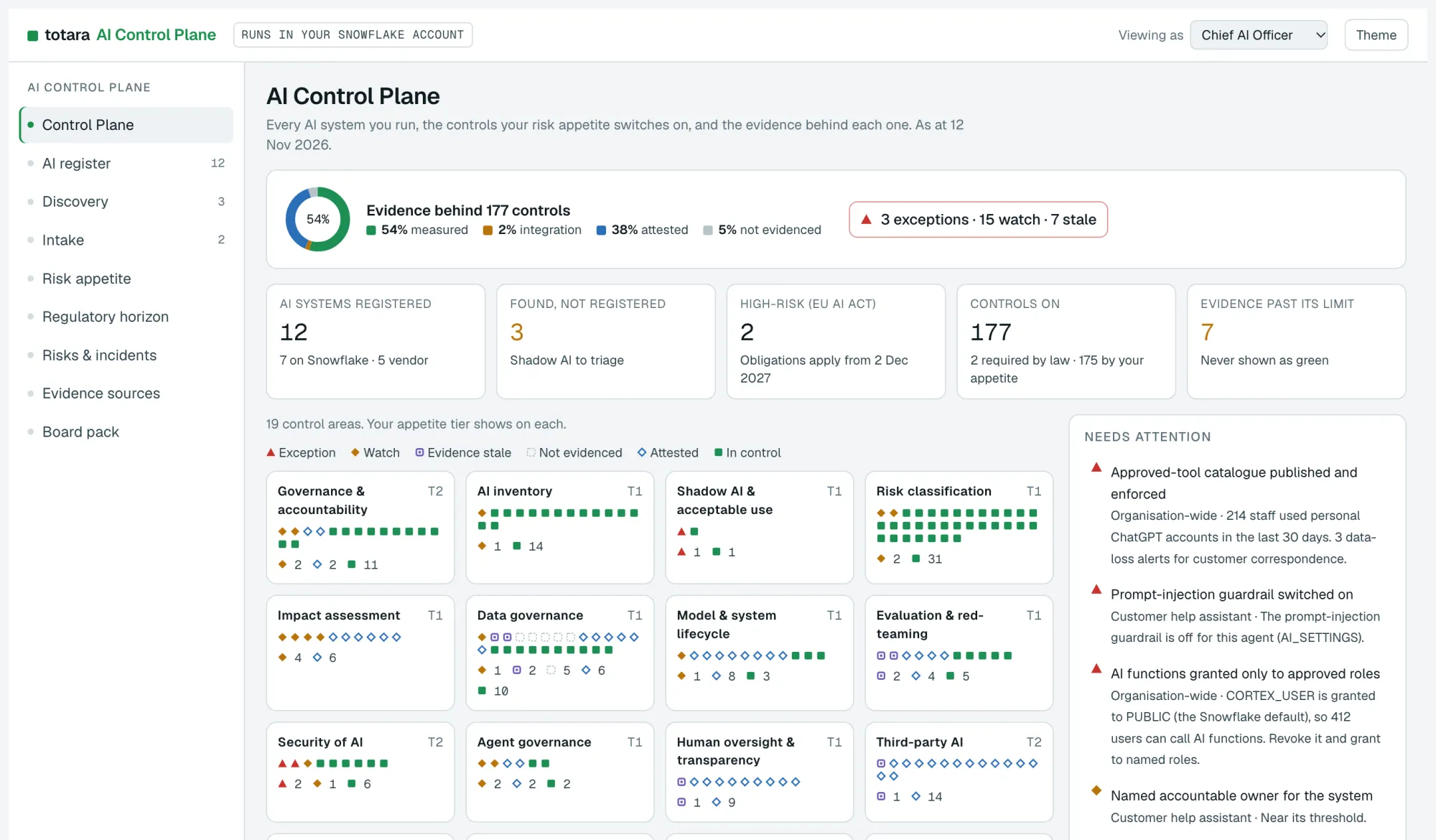
The AI Control Plane home screen: the evidence behind 177 controls (54% measured, 2% from integrations, 38% attested, 5% not evidenced), counts of registered AI systems, shadow AI found, high-risk systems and stale evidence, 19 control areas with their status, and a list of items needing attention.
What your Chief AI Officer sees first.
1 · Coverage

See all of it

Every model, vendor, agent and shadow tool on one register, traced to the laws that apply, with an intake gate for new uses.

2 · Appetite

Set the risk you'll accept

Set an appetite for each area and the matching controls switch on, including good practice nobody mandates yet.

3 · Evidence

Prove it, honestly

Where your AI runs on Snowflake, evidence is collected automatically. Every control shows how fresh its evidence is, and stale evidence never shows as green.

Built for regulated work, ready for any industry

The engine was built for banks, where every control must stand up to a regulator. Controls map to ISO/IEC 42001, the NIST AI Risk Management Framework, the EU AI Act and the rules regulators apply to AI locally. Sector packs sit on a cross-industry core, so a bank and a water utility each start from the controls that matter to them.

Also included: impact assessments, incident clocks, AI literacy records, third-party AI and a dated regulatory horizon.

05Using AI

Five ways to use AI, each with its own controls

"Using AI" covers very different things. We sort every use into one of five types, from most controlled to most autonomous, because each needs different controls.

TypeWhat it isWhat runs in productionControlsRisk
AI that buildsA forecasting model, a data pipeline, a rule set AI helps build code, rules or models. People test and release them. Deterministic. The tested code or model runs, not the AI. Code review, testing before release, version and lineage. Low to medium
AI for insightsExtracting obligations from contracts, flagging anomalies Agents find, prepare and interpret data inside a designed process. Not deterministic, but structured outputs that can be checked. Guardrails, output checks, measured accuracy, human review by risk. Medium to high
AI you ask"Which assets failed most after last week's storm?" Staff or the public ask in plain language; the AI answers from the data it's given. Not deterministic: an answer in words, with sources. Cited answers. For the public: published data only, and hand-over to a person. Medium; high for the public
AI for efficiencyDocuments, meetings and email AI helps people draft, summarise and search their own work. A draft a person owns. Approved tools only; no sensitive data in anything else. Low
AI that actsRaising work orders, sending messages, approving transactions AI changes systems or makes decisions without a person approving each step. Not deterministic, and it acts before anyone checks. Limits on every action, approvals, undo and full audit. High
Which type?
  1. Used as evidence, or run again and again in a regulated process? AI that builds: build a tool, test it, run the tool.
  2. Does a system use what the AI produces? AI for insights, with a fixed output format and checks.
  3. Is a person asking to understand something? AI you ask, with public guardrails if it's the public.
  4. Is it a person's own document, email or meeting? AI for efficiency.
  5. Would the AI act on its own? AI that acts. Most organisations should redesign it so a person approves each action.

The first "yes" gives the type.

06Six terms

Six terms everyone using AI should know

In plain words

Deterministic

Same input, same answer, every time, like a calculator. Most AI isn't: ask twice, get two answers. Fine for a draft; for regulated work, use AI to build a tool, test it, and run the tool.

Watch out for

Hallucination

AI can state something wrong with full confidence: a number, a reference, a rule that doesn't exist. Check the facts that matter, and ask for sources.

In plain words

Guardrails

The fences around an AI: what data it sees, what it may answer, and when it hands over to a person. Public-facing AI sees published information only.

Watch out for

Drift

Results change without anyone deciding they should: a long task loses its thread, the supplier ships a new version, or the world moves on. Write down what the AI must do, and test against known answers.

In plain words

Human in the loop

A person checks or approves AI output before it's used, more so as risk rises, with the time, knowledge and authority to say no.

Watch out for

Sycophancy

AI leans towards telling you what you want to hear: it backs a weak idea, or drops a right answer when you push back. Don't lead the question, ask for the weaknesses, and judge results against tests, not confidence.

07How we work

The answer first, then the reasoning

Every piece of work opens with the answer on one page: what we recommend, why, and what it depends on.

What you getThe question it answers
StrategyWhere are we going, and in what order?
Current-state mapWhat do we have today, and how does it fit together?
Architecture principlesWhat rules do our decisions follow, and why?
Impact assessmentWhat does this change, and is it ready to fund?
Solution assessmentDoes this product or design fit our estate, and on what conditions?
Decision recordWhat did we decide, what did we reject, and why?
08People

Directors

Ross Millen

Ross Millen

Director

More than 25 years designing data and financial-services platforms in 15 countries. Ross leads our strategy and architecture work and the AI Control Plane.

LinkedIn
Melanie Gabriel

Melanie Gabriel

Director

Melanie brings corporate and financial accounting experience from some of New Zealand's biggest companies, and has delivered large financial transformation programmes.

LinkedIn
09Contact

Talk to us

Tell us what you're trying to decide or deliver. We'll tell you plainly whether we can help.

Email Ross
Email
[email protected]
Offices
Auckland, New Zealand
London, United Kingdom
Banking
totara.global